Convocation Program
The Class of 2026

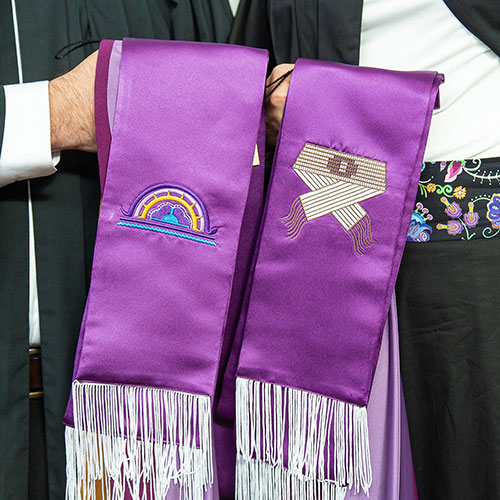
Indigenous graduates will receive a unique stole with symbolic meaning. One side of the stole depicts the Dish with One Spoon Treaty Wampum Belt between the Haudenosaunee and Anishnaabe. This land is part of the Dish with One Spoon Treaty between the Haudenosaunee and Anishnaabe peoples and symbolizes the agreement to share, protect our resources and not to engage in conflict.
On the other side of the stole is the Office of Indigenous Initiatives logo. Based on the Haudenosaunee creation story, our logo reminds us of how the first seeds of life on Earth were planted on the back of a turtle. The inner segments of the dome represent the Anishnaabe (Ojibway) Seven Grandfather Teachings: love, respect, wisdom, bravery, truth, honesty and humility. The golden rays of the sun symbolize enlightenment, learning and new beginnings. The Métis beaded purple flower represents the gifts of plant life from the Skyworld, which encourage and sustain life. The entire design rests on the waters of life.
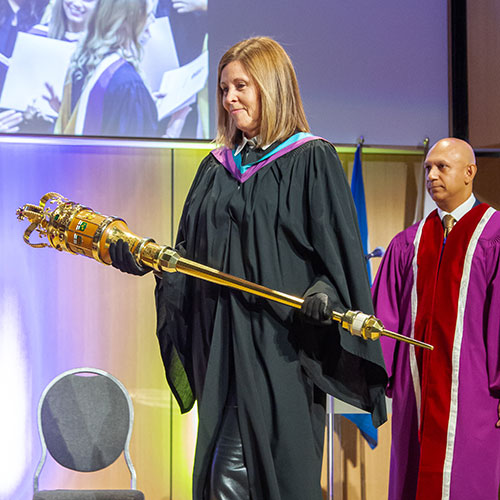
The mace of Wilfrid Laurier University was officially presented by the Euler family at the 1963 fall convocation in memory of The Honourable W.D. Euler, former senator of Canada and the first chancellor of the university. It weighs 16 pounds and was manufactured by the firm of Henry Birks Limited, Montreal.
The ferrule near the base of the shaft contains ivory from a walrus tusk obtained from Coral Harbour, Northwest Territories. The ten-sided shaft, representing the ten provinces, merges into the head of the mace which bears the ten provincial crests. The wood used at the point where the shaft meets the head of the mace is elm taken from the bannister post of Conrad Hall, the original seminary building. Above this are four crests relating to the history of the institution: a crest of Waterloo County, the Luther Coat of Arms, the crest of the Waterloo Lutheran Seminary and the coat of arms of the University of Western Ontario.
The head of the mace is made of maple and bears the Federal Coat of Arms, above which is the monogram of Queen Elizabeth II, during whose reign the university's charter was granted. On the reverse side is the crest of Wilfrid Laurier University and the monogram of King George V, during whose reign the original charter was granted. The top of the mace is a crown, mounted with jewels, symbolizing the authority of the State.
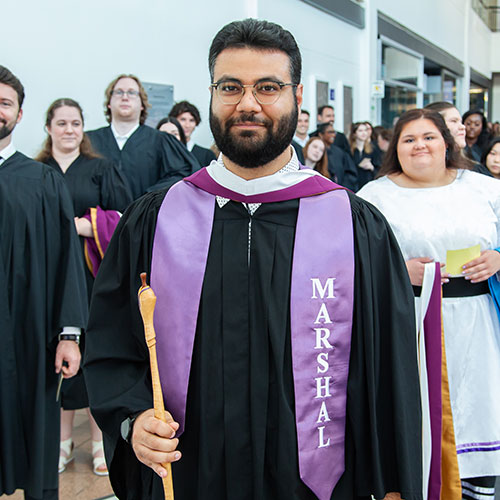
Dr. Fred Binding, a faculty member in the Department of Psychology for 32 years retired in July 2003. He had served as the university marshal for ten years. Sadly, Dr. Binding died in August 2003. In memory of his contribution to convocation ceremonies, artist Rex Lingwood was commissioned to create a marshal's baton.
In the baton, the artist incorporates a range of visual references that relate to the graduation ceremony, both directly and symbolically. In keeping with the nature of the ceremony, some of the forms are traditionally associated with ceremonial staffs, and the baton's design echoes the elaborate theatricality of the event and the flair brought to the occasion by Dr. Fred Binding. The ends may be read as abstracted figure forms wrapped in the academic gown and hood, with details symbolizing the life stage of the graduates. The Greek alphabet is inset into the internal side surface in the shaft of the baton. This is a reference to the interests of Dr. Fred Binding. It also acknowledges that language is at the core of university education and that the Greek language has particular importance in western culture.
The commission of the baton was made possible with the generous support of the Department of Psychology and Wilfrid Laurier's University Retirees' Association.
The academic degree is a title conferred on an individual by a university as recognition of the completion of a course of study or for a certain attainment. In Canada, the three stages in higher education are represented by the degrees of bachelor, master, and doctor. Wilfrid Laurier University is given the authority to grant degrees by the Wilfrid Laurier University Act.
The bachelor’s degree is awarded at the honours, without honours or general specified, or the general level. An honours degree program emphasizes the acquisition of a broad and deep knowledge of the student’s chosen honours subject. The four-year bachelor's without honours or general is awarded to students who have met all honours course requirements and includes their specialization. A general degree program emphasizes a balance between an in-depth understanding of the student’s major subject and a knowledge and appreciation of other fields.
The master’s degree is the second degree in higher education. Students complete concentrated and specialized work at a more advanced level in an academic discipline or professional area. Most course work is within the field of specialization and a research project or thesis is normally required. Some master’s degrees provide professional qualifications.
The doctoral degree is the highest academic degree granted by a university. Candidates for the degree spend several years in the advanced study of a specialized field of knowledge. The capstone of the degree is the doctoral dissertation, an extended work based upon independent research. The dissertation demonstrates the candidate’s command of both the subject matter and the exacting methods of scholarship, and makes an original contribution to knowledge.

Honorary Doctor of Laws | Presented on Oct. 15, 1:30 p.m., Waterloo
Ed Devlin is the founder and managing partner of Devlin Capital, an investment firm focused on the global fixed income markets. A graduate of Laurier with a Bachelor of Business Administration, Devlin was awarded the university's Gold Medal for academic excellence. He earned an MBA from the Tuck School of Business at Dartmouth College. Before founding Devlin Capital, Devlin spent nearly 15 years at Pacific Investment Management Company (PIMCO) as a managing director and head of Canadian portfolio management. He co-founded PIMCO Canada, helping grow its assets to more than $50 billion from Canadian clients. He is a senior fellow at the C.D. Howe Institute. Devlin also chairs the endowment board of the Stratford Festival.

Honorary Doctor of Laws | Presented on Oct. 20, 2 p.m., Brantford
Jason Dunkerley is a celebrated Paralympian, author and advocate whose life story exemplifies resilience, perseverance and hope. Born blind due to Leber’s congenital amaurosis, a rare inherited eye condition, Dunkerley discovered running as a student and went on to build one of Canada’s most distinguished Paralympic track careers, earning five Paralympic medals in addition to his four world championship titles and multiple Parapan American Games medals. Dunkerley has overcome significant challenges throughout his life, including suffering injuries after being struck by a car, donating a kidney to a family member and coping with profound personal loss. His 2024 autobiography, Visions of Hope: Running Towards My Own Truth, reflects on these experiences with honesty and insight.
Graduates listed in this program have been certified as completing all degree requirements as of Oct. 6, 2026.
Arash Rafat
Faculty of Science
Arash Rafat
Faculty of Science
Natalie Liz Aldor
Faculty of Science
Laura Angeline Barron
Lyle S. Hallman Faculty of Social Work
Zoe Alexandra Ironstone Catterall
Faculty of Arts
David Alan Claeys
Faculty of Science
Guy Brandon Copegog
Lyle S. Hallman Faculty of Social Work
Valdrin Dragusha
Faculty of Arts
Gabriella Analena Ellingham
Lazaridis School of Business and Economics
Anissa Marie Francis
Faculty of Science
Zhenni Gu
Lazaridis School of Business and Economics
Jessie Lynn Kingma
Faculty of Education
Isabella Grace Murray
Faculty of Arts
Kelsey Rae Piche
Faculty of Education
Inderjit Singh Saini
Faculty of Arts
Yuvraj Sidhu
Lazaridis School of Business and Economics
Anastasia Olympia Townshend
School of International Policy and Governance
Natalia Grace Catherine Van Esch
Faculty of Science
Michael Babin
Faculty of Human and Social Sciences
Jason Campbell Barrick
Lazaridis School of Business and Economics
Amanda Lynn Braam
Faculty of Music
Erika Tin Wai Chow
Lazaridis School of Business and Economics
Kyle Anthony Andre Cornacchi
Lazaridis School of Business and Economics
Aleksa Andrianna Martino
Faculty of Arts
Joshua Jeffrey Milmine
Faculty of Science
Alexis Elizabeth Pankarican
Lazaridis School of Business and Economics
Suraj Rakesh
Lazaridis School of Business and Economics
Lydia Catherine Serbanescu
Faculty of Science
Nina Helena Wulff
Faculty of Science
Clayton Joseph Harding
Faculty of Liberal Arts
Alexis Rhonda MacLennan Mckeen
Faculty of Human and Social Sciences
Sevval Betul Uyar
Lyle S. Hallman Faculty of Social Work
Laverne Good
Faculty of Arts
Congratulations on your graduation – you made it! Today, we welcome you to the Wilfrid Laurier University Alumni Association (WLUAA).
You are now a member of a community of more than 140,000 proud graduates of Wilfrid Laurier University and its predecessors.
WLUAA represents all Laurier alumni, including you. We support Laurier with revenue from alumni services, such as group home, auto and life insurance, and an alumni affinity credit card.
WLUAA revenues help to fund alumni programs and events, university initiatives, student groups, and student scholarships.
The association’s mission is to engage and represent a community that supports and enriches our alumni, students, and the university. We share a vision for an inspiring community of engaged alumni.
You are alumni for life — your relationship with Laurier doesn’t end today. Stay connected as a proud grad and learn more at LaurierAlumni.ca.
