
We use cookies on this site to enhance your experience.
By selecting “Accept” and continuing to use this website, you consent to the use of cookies.
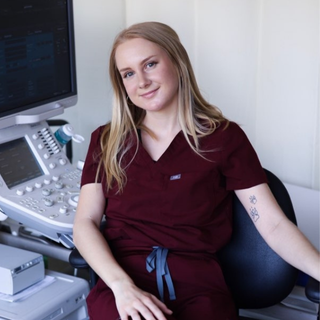
As a Health Sciences student, Madison loved biology, anatomy and genetics, and had a particular interest in women’s health. After some exploring, she realized she wasn’t interested in a purely laboratory-based role but was instead keen on a position that held more direct people interaction. Madison ultimately narrowed her ideas down to the ultrasound and midwifery field. She initiated numerous coffee-chat conversations with professionals in both fields to help inform her decision-making. From this career investigation, it became apparent that the midwife profession came with a lot of work schedule uncertainty given the nature of the work (babies arrive on their own schedules!) In contrast, while the ultrasound profession may at times have on-call hours, it typically entails a more predictable schedule, which felt like a better fit for Madison’s lifestyle preferences.
Following her degree, she pursued admission to Michener’s Ultrasound Technician Advanced Diploma Program. While you can apply to ultrasound programs straight out of high school, there are accelerated programs for people who have completed a degree. Madison notes that you can come from a variety of different undergraduate majors, so long as a few pre-requisite courses are fulfilled. Madison completed an 8-month placement in a clinical setting working with real patients, performing imaging on everything except the heart, as that is a separate program/field (echocardiogram). Within her placement, she was strongly encouraged to gain hospital setting experience to test the differences in the role between the two environments. Clinical settings tend to be more independent work and deal more with cases referred from family physicians, whereas hospital settings, your team collectively shares the patient queue, so there can be a bit more time in between patients. Hospital referrals come from family and hospital physicians, surgeons, and emergency care physicians, meaning you see more urgent priority cases in a hospital setting. Madison notes that a hospital in a larger urban center presents more diverse health imaging cases and patient care demands since bigger hospitals generally have more specialized health services. Madisons’ hospital is the region's cancer, stroke and renal centre.
A day in the life of an ultrasound technician is very extroverted and patient-facing. Madison greets approximately 12 patients per 8-hour shift and performs the prescribed exams. Following the exam, she is expected to write up a technical document offering the radiologist insight into what they observed during the session. This information is considered as the radiologist arrives at their own assessment and final diagnostic report. As in any health care position, Madison must follow health protocols to clean the space and equipment between patient use.
Madison mentions that if you are an anatomy buff, like her, it can be fascinating to look at ultrasound images. The human body is extraordinary, and she finds it exciting when observing something she’s never seen before. It’s particularly rewarding to work with the same clients over time who are healing from a procedure or reviewing pre- vs. post-surgery images to see the positive improvements and progress they have made. It’s also a joy to provide pregnancy ultrasounds to observe the progression and development of life and collect the important data that’s necessary to facilitate a healthy delivery. As an ultrasound technologist, there is the opportunity to image a patient during pregnancy and then later, perform an ultrasound on the same child post-birth. Witnessing the continuity of care from prenatal to pediatric imaging is both meaningful and professionally gratifying. Madison does note that most clients are one-time visitors only, such as emergencies or outpatients. Therefore, it is not always the case that you will conduct the follow-up imagery for that same patient.
Madison feels lucky to be working at a hospital that is fully staffed; however, many clinics are understaffed making the position in high demand. That places a lot of strain on those ultrasound technicians to keep up with high patient volume. Madison mentioned that class sizes for ultrasound are often in the 25-person range, so we are not training enough technicians to keep up with the health care demands of our ever-expanding Canadian population. On the plus side, this makes your employment prospects very high as you are in a skilled profession in strong demand.
Given the predominantly independent nature of the role, ultrasound will be a better fit for you if you thrive on autonomy. While the role is strongly independent, Madison does have access to supportive colleagues she can bounce ideas off or share her images to brainstorm their assessments. You must also possess strong communication skills, as there is a high degree of patient interaction and you are meeting patients at a time in their lives when they may be undergoing sensitive diagnostic procedures or facing concerns about their health. Learning the art of asking good questions and appropriate timing in the patient appointment to ask questions is key. For instance, it’s helpful to collect as much health history before the scanning commences because if you ask a question during the procedure, it might frighten a patient, causing them to have anxiety that something was seen on the image that is cause for concern. Also, ultrasound technicians cannot legally verbalize their assessment to a patient. Occasionally, you have patients who insist that the technician tell their opinion, so you must be kind but firm in respecting the legal scope of the role.
If interested in a medical imaging profession, it makes sense to also conduct research on MRI, CT scans, Echocardiogram and X-ray, to see which profession you might find most interesting.
Students interested in ultrasound should check out the Canadian Association of Medical Radiation Technologists and Sonography Canada. Madison participated in a student group project using contrast-enhanced ultrasound to improve diagnoses of liver pathologies, which was highlighted in a Sonography Canada webinar. These organizations oversee quality assurance and continuing education credits to help ultrasound technicians stay on top of new research and developments in the field.
Contact Us:
Visit our locations and contacts page for office locations and service hours.