
We use cookies on this site to enhance your experience.
By selecting “Accept” and continuing to use this website, you consent to the use of cookies.

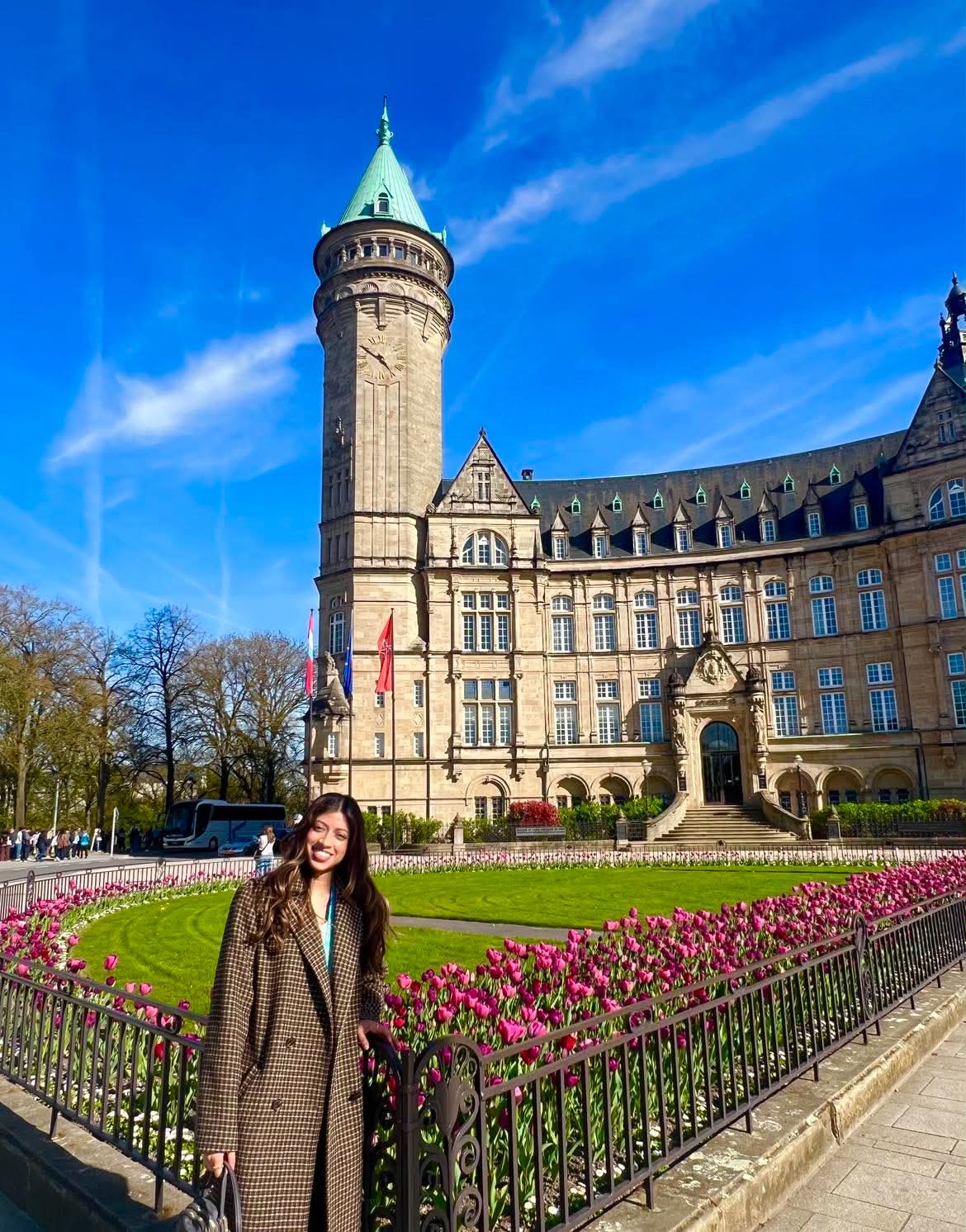
Amerie Desouza is a banking, finance, and economics professional with a growing specialization in prudential banking regulation, risk analysis, and financial compliance. She began her academic journey with a Bachelor’s degree in Economics at Laurier, then went on to earn a Master's in Banking and Financial Regulation from the Universidad de Navarra in Madrid, where her thesis developed a composite risk indicator for Canada's systemically important banks. She has worked with the European Banking Federation in Belgium along with the Canada Revenue Agency, and the United Nations Economic and Social Commission for the Asia Pacific.
Why did you choose to study economics at Laurier?
I was drawn to Laurier's smaller campus feel. I wanted an environment where I could actually get to know my professors and classmates, rather than feeling like a number in a lecture hall and I was drawn to economics in high school, I wanted a deeper understanding of the invisible hand.
What is one thing you remember best from Laurier?
It's less of a single moment and more of a feeling. Walking across campus in the fall, when the leaves were turning and everything had that crisp, auburn haze. Grabbing a coffee on campus with classmates who later turned into the closest friendships I cherish.
What are you working on currently and what do you find most exciting about it?
I'm currently self-studying anti-money laundering (AML). It's a fascinating world, that sits at the intersection of economics, law, criminology and global finance. It constantly reminds me that economic systems aren't just abstract models, they're actively shaped by people either trying to exploit or protect them.
What advice would you have for students starting out in Economics?
Don't be intimidated by math, it's a tool, not the point. The real skill is learning to turn numbers and statistics into a story. Once you can take a dataset and explain what it actually means for people's lives, you've understood economics, not just how to calculate it. Also, try to emerge yourself into its world via reading. The library at Laurier holds an extensive list of books that can really provide an entertaining lens through which to view economics.
Was there anything you learned that you didn't expect to be useful later on but that was (or vice versa)?
I didn't expect how much my economics background would change the way I consume the news: mainly how much political noise I can see through now.
Is there some industry or job area where you think there are underappreciated opportunities that economics students should consider looking into?
I think game theory is an underexplored space for students of economics. It underpins a lot of global work, in negotiations, strategy, policy design etc. Economics, like physics, forces one to think outside the box, to theorise and predict. Game theory is the machine that puts that mode of thinking to work.
How did you end up doing a Master's degree in Spain and what are your takeaways from that experience?
As an economics student, I was always fascinated by the global sphere, I wanted to experience the world beyond the classroom, so studying abroad was always a goal of mine. Madrid, as a major global city, felt like the perfect place to pursue that dream. Moving to a new country without knowing a single person and without speaking the language was one of the hardest decisions I made, but the payoff is huge. My biggest takeaway is that it's never too late to invest in your education, and when it comes to your own life, you're the only one who can truly invest in the future you desire.
Did you know Laurier’s economics department has a newsletter that you can subscribe to? Sign up at: https://bit.ly/lednewsletter . You can check out all of our articles hot off the presses as they come out on the site (accessed through the link) as well!