
We use cookies on this site to enhance your experience.
By selecting “Accept” and continuing to use this website, you consent to the use of cookies.
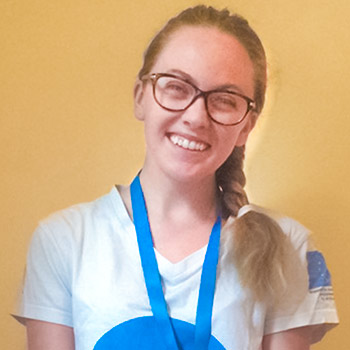
Melanija Popovic works as a project manager and communications officer at the NGO Asylum Protection Centre in Belgrade, Serbia. She takes part in designing and participating in projects to help integrate migrants and asylum seekers and to protect their rights.
Laurier’s Anthropology program was key to establishing the foundation that enabled me to pursue my passion: the field of migrant and asylum seekers’ rights. Pursing a Combined Honours Degree in Anthropology and Political Science was a logical way for me to enter the field of International Relations. The only way to analyze politics transnationally is to fully understand the socio-cultural background of the country and people in question. The courses AN300: Ethnographic Methods and AN400: Doing Fieldwork were particularly important in teaching me about research design and how to do fieldwork about politically sensitive topics. The skills I acquired in these courses directly relate to the job I have today working in the project management and communications sector at an NGO that protects migrant and asylum seekers’ rights and safety in the Republic of Serbia.
After graduating from Laurier, I decided to apply to a master’s program abroad that would enable me to engage both anthropology and political science. I was accepted to Hochschule Furtwangen University’s master’s program in International Relations and Cultural Diplomacy where half of my studies were spent with the Institute for Cultural Diplomacy in Berlin. It was here that I was able to see how much Laurier’s Anthropology program thoroughly prepared me in terms of research methods, research ethics, and understanding cross-cultural conflict resolution. All of the anthropology courses I took during my undergraduate degree provided me with a solid background in anthropological methods that has enabled me to successfully analyze the political and cultural differences I encounter in my work.
Shortly after concluding my master’s degree I moved to Belgrade, Serbia to find an internship in the field of International Relations. I was accepted as an Intern in the Project Management Division of the NGO Asylum Protection Center in Belgrade. During my internship, I prepared project proposals about integrating migrants and asylum seekers, and was directly involved in assisting with asylum procedures and ensuring that asylum seekers’ human rights were protected. Because the NGO has a legal, psycho-social and integrative sector, I have worked on topics and issues that I spent my undergraduate and postgraduate career reading and writing about. After three months of interning, I was offered a full-time contract. This has enabled me to continue to learn skills I have been developing since my undergraduate degree and to apply them to a field directly relating to migrant integration and cultural diplomacy. My current job involves organizing integration workshops across migrant field camps. Thanks to the research and ethics training I received in Laurier’s Anthropology program I feel well-prepared to do this work and to engage with cultural difference in all walks of life.